R&D · Engineering · Innovation

AlfaTherm Heat Transfer Technology

Advancing thermal engineering through computational fluid dynamics, additive manufacturing, and next-generation plate geometry optimization.

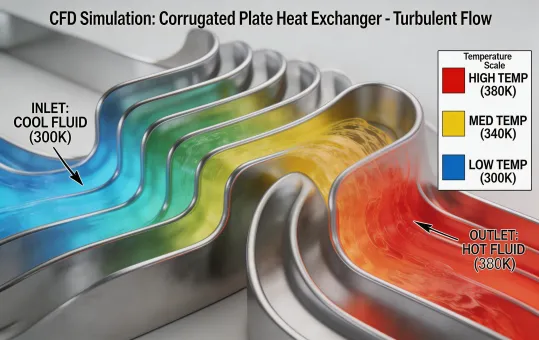
CFD simulation of plate heat exchanger flow patterns

CFD-Optimized Plate Geometry

Every AlfaTherm plate pattern is designed through iterative computational fluid dynamics (CFD) simulation. Our proprietary corrugation profiles maximize turbulent heat transfer while minimizing pressure drop, achieving heat transfer coefficients exceeding 7,000 W/m²K for water-to-water applications.

Heat Transfer Coefficient > 7,000 W/m²K
Approach Temperature 0.5°C minimum
Plate Thickness Range 0.4 - 1.0 mm
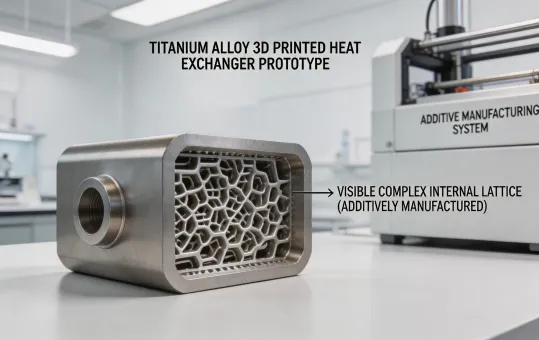
Additive manufacturing heat exchanger prototype

Additive Manufacturing R&D

Our additive manufacturing program explores metal 3D printing for heat exchanger internals with lattice geometries impossible to produce through conventional stamping. Triply periodic minimal surface (TPMS) structures increase surface area density by 40% compared to traditional chevron plates, enabling radical miniaturization.

Surface Area Increase +40% vs. conventional
Materials Ti-6Al-4V, 316L SS, Inconel 625
Build Volume 400 x 400 x 500 mm
Refrigerant Technology Platforms

Heat exchangers engineered for the global transition from high-GWP HFCs to natural and low-GWP synthetic refrigerants.

Refrigerant Type GWP Design Pressure Applications AlfaTherm Platform
R-744 (CO2) Natural 1 Up to 130 bar Transcritical commercial refrigeration AT-CO2 Series
R-717 (NH3) Natural 0 Up to 25 bar Industrial cold storage, food processing AT-NH3 Series
R-290 (Propane) Natural 3 Up to 20 bar Commercial chillers, heat pumps AT-HC Series
R-1234ze(E) HFO 7 Up to 18 bar Centrifugal chillers, data centers AT-HFO Series
R-513A HFO Blend 631 Up to 20 bar Retrofit for R-134a systems AT-Retrofit Series

Technical Trade-offs: HFC Phase-Down Transition Paths

The Kigali Amendment and EU F-Gas Regulation (revised 2024) mandate a global shift away from high-GWP HFCs. The industry remains split on the optimal replacement strategy. Both pathways have engineering merit, and the right choice depends on application context.

Natural Refrigerants (CO2 / NH3 / R-290)

Proponents argue that natural refrigerants offer zero or near-zero GWP (CO2 = 1, NH3 = 0, propane = 3), eliminating long-term regulatory risk. CO2 transcritical systems have proven viable even in warm climates above 35°C ambient with parallel compression and ejector technology. Operating costs are lower at scale due to freely available refrigerants with no patent dependencies. Ammonia delivers the highest COP among all industrial refrigerants at evaporating temperatures between -40°C and +5°C.

Synthetic Low-GWP HFOs (R-1234ze / R-513A)

HFO advocates emphasize drop-in or near-drop-in compatibility with existing R-134a infrastructure, reducing retrofit costs by 40-60% compared to natural refrigerant conversions. HFOs are non-flammable (A1 safety class for blends like R-513A) and non-toxic, avoiding the machinery room requirements and charge-limit restrictions of ammonia and propane. The existing HVAC/R technician workforce can service HFO systems without additional safety certifications, accelerating adoption timelines.

AlfaTherm designs heat exchangers for both pathways. Our AT-CO2 and AT-HC Series serve natural refrigerant applications; our AT-HFO and AT-Retrofit Series support synthetic low-GWP transitions. Selection should be guided by a total-cost-of-ownership analysis over the 15-20 year equipment lifecycle.

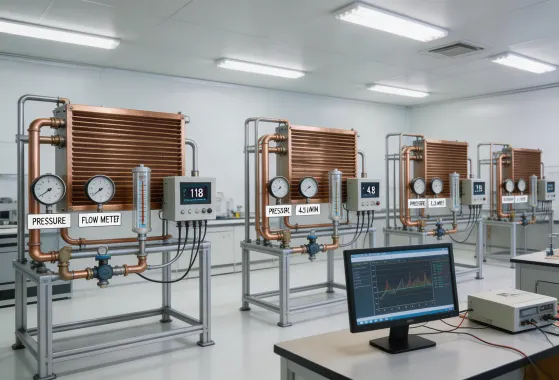
AlfaTherm thermal testing laboratory

Testing & Validation Laboratory

Our ISO 17025 accredited test facility validates thermal performance, pressure integrity, and fatigue resistance under conditions exceeding field operating parameters.

  • Thermal performance testing per AHRI 400/AHRI 410 standards
  • Hydrostatic pressure testing to 1.5x design pressure (PED Category III/IV)
  • Thermal cycling fatigue testing: 10,000+ cycles at design delta-T
  • Fouling simulation and CIP cleaning validation
  • Vibration and acoustic emission analysis for shell-and-tube units
  • Helium leak detection to 1 x 10&sup-6; mbar·L/s sensitivity

Engineering Constraints & Selection Boundaries

Transparent disclosure of operating limits helps engineers specify the correct heat exchanger type for each application.

Plate Heat Exchanger Pressure Ceiling

Gasketed plate heat exchangers are limited to approximately 25 bar design pressure and 180°C maximum operating temperature. Applications requiring higher pressures (such as HP feedwater heaters at 40+ bar or supercritical CO2 loops above 130 bar) must use shell-and-tube or welded plate configurations, which carry higher cost and longer lead times.

Fouling Sensitivity in Plate Geometry

The narrow plate channels (2-5 mm gap) that enable high heat transfer efficiency also make plate heat exchangers susceptible to fouling by particulate-laden fluids, fibrous media, or scaling water. Applications with total dissolved solids (TDS) exceeding 500 ppm or suspended solids above 50 ppm require additional pre-filtration or may need shell-and-tube designs with wider tube clearances.

Natural Refrigerant Safety Requirements

R-717 (ammonia) systems require machinery rooms with gas detection and emergency ventilation per ISO 5149 and ASHRAE 15, adding 15-25% to installation cost. R-290 (propane) charge limits under EN 378 restrict standalone commercial units to approximately 150 g per circuit in occupied spaces, limiting cooling capacity to roughly 15 kW without secondary loop designs.

Additive Manufacturing Maturity

Metal 3D-printed heat exchanger internals are currently limited to prototype and low-volume production. Maximum build volume is 400 x 400 x 500 mm, restricting TPMS-geometry units to small-capacity applications below 50 kW. Surface finish (Ra 6-12 μm as-built) requires post-processing for sanitary or pharmaceutical-grade applications. Full production scaling is projected for 2027-2028.

Engineering White Papers

Access our technical library covering heat exchanger selection, refrigerant transition strategies, fouling mitigation, and total cost of ownership models.

Request Technical Library Access